I Hit the Jackpot!
Broke Down in Beatty, Nevada
Driving I-5 south through Kern County, I realized I’d forgotten to pack a sleeping bag.
That was a problem. It was long after dark, and I was due to meet Ted—that’s my dad—and his wife Laura in Shoshone the next morning. Without a sleeping bag, it would be cold sleeping in the truck tonight. And there would be no way to get equipped before our camping vacation in the desert.
In Bakersfield, I found a Target open. Inside, I bought a big bulky Coleman sleeping bag, the new CD from Green Day, American Idiot, and a $10 CD player to play it on. Sometime after midnight I was snuggled down in the bag in a spot off the Harry Wade Road, in the southernmost reach of Death Valley National Park.
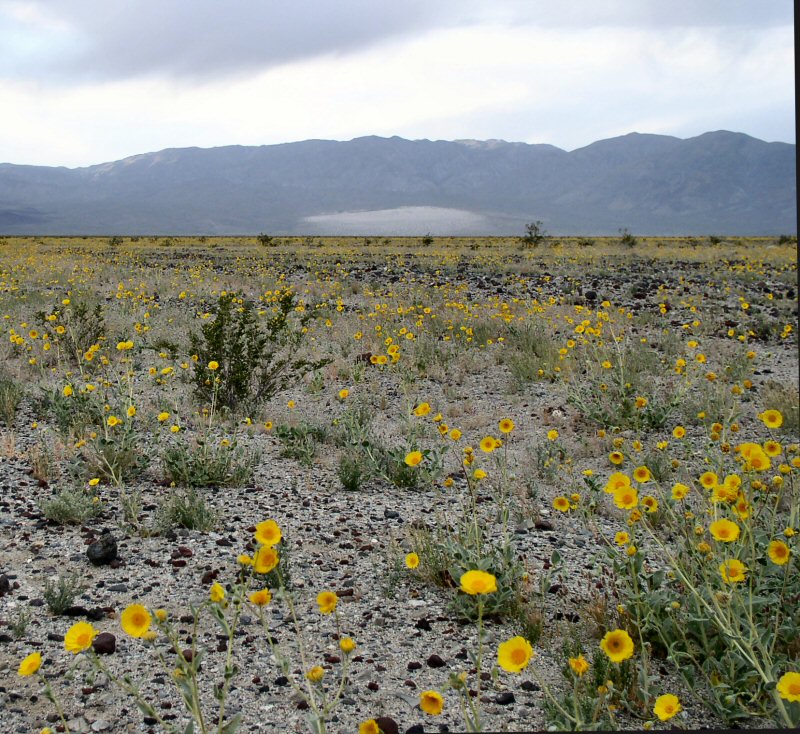
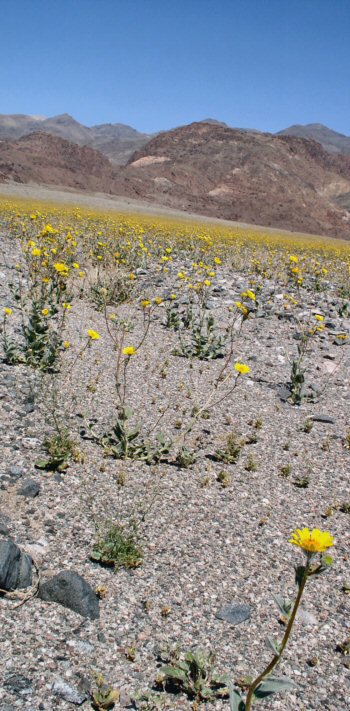
Our camping vacation started out pretty well. The road into Gold Valley was rough, but with only a couple of spots to challenge the full-sized 4WD pickup. The wildflowers were spectacular. The camp setup was comfortable.

The next day we made a side trip up the Greenwater Road to Dante’s View; then we drove back to Shoshone. We picked up Ted and Laura’s rental car and drove caravan-style up the Badwater Road. It was fiercely hot in the valley.
The real adventure started, I guess, when we pulled into the visitor’s center at Furnace Creek. I noticed something dripping underneath the truck—condensation from the air conditioner, I decided.
Dumb. There shouldn’t have been any condensation in the desert, where the humidity is near zero. You always think of these things only later, after the trouble starts.
We left the rental car in the visitor’s center parking lot and headed for a spot where I’ve always wanted to camp—the bottom of Monarch Canyon Road. The transmission started slipping on the way down the canyon. We got to the end of the road just as the truck’s transmission dumped the last of its fluid.
A few minutes later, by fortuity, a woman drove an SUV alongside. She was looking for a place to camp before it got dark. She promised to come look for us in the morning.
It was a beautiful evening. We set up camp and watched the last light fade on the twisted, folded canyon walls.
In the morning, Jennifer—she’s a respiratory therapist from Santa Cruz—drove me back to the visitor center. I bought her a tank of gas and a copy of Digonnet’s book, and thanked her as much as I could. Then I picked up the rental car and went to the gas station there at Furnace Creek.
The gas station guy gave me the name of two towing services. I called the one in Beatty. A lady said I should call “John” and gave me his cell number.
I called John and told him my problem.
“GoddAMN it!” he said.
“That’s what I said,” I said.
We met up where Monarch Canyon Road starts, marked only by a “4WD” sign on the shoulder of Highway 374. I could see two old guys in a beat up, but well-maintained, flatbed wrecker. I squeezed into the cab beside John’s friend, Merrill, and we proceeded to bump and sway down the old mining road. John opened a pack of Winstons, threw the top wrapper out the window, and lit a cigarette.
“GoddAMN it!” he said. “Why can’t they fix these goddamn roads.”
John got my truck out of there, no problem. It was a nice piece of field engineering. He used a chain to tow the truck a ways up canyon, then let it roll gently back down and part way on to the flatbed before winching it the rest of the way on.
Ted and Laura rode with John in the cab of the wrecker. Merrill and I climbed up onto the bed of the wrecker and eased ourselves into the cab of my now-cinched-down truck. It swayed like a ship in a storm, but didn’t slide much.

When we reached the paved road, Ted and Laura and I got in the rental car and followed the old wrecker into Beatty. John checked his watch as we arrived at his yard. Towing was $150 an hour.
The yard wasn’t much to look at. There was some outdoor working space in an area surrounded by junked cars. John used his wrecker for a hoist. Tools were stored in truck trailers, like at a construction site. He told me how much a new transmission would cost. I asked him for a written estimate, and he called his wife, Rose, to come down to the yard with some blank work orders. He wrote one out left-handed in careful, block letters. I signed it.
That done, he told us to follow him—he’d exchanged the wrecker for a Crown Vic—and we drove behind him through the dry, nearly abandoned streets of Beatty.
In the restaurant of the Burro Inn—a restaurant, motel, RV park and casino—the air was stale and smoke-filled. I ushered our group toward the no-smoking section. He recommended a burger with mashed potatoes and gravy, so I ordered that.

Beatty isn’t Berkeley.
“Here’s what you do,” John said. “Everybody flies home. I’ll have this done in a week, maybe a week and a half.”
Ted and Laura still had two days—plus the rest of the afternoon—before their flight back to Albuquerque. We looked for a motel in town.
The clerk at the Motel 6 insisted everything in town was booked, but Laura thought to ask at the local historical museum. Ted and I waited in the car outside. The day was awful hot.
Laura came back with a wan smile. The attendant had called around and found us rooms—back at the Burro Inn.
Hell, at least the rooms had showers. I got cleaned up and headed into the casino to find an ATM. I owed John $375 cash for the tow.
I found John and Merrill were sitting at a table in the restaurant, smoking. I gave John the cash. We talked a bit about Beatty and about the towing business.
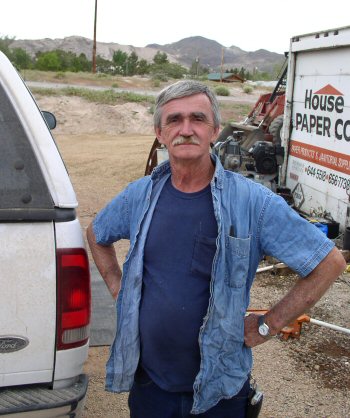
I wasn’t sure about John. I didn’t have any choice except to trust him. He seemed kind of wired. I couldn’t tell how much of his braggadocio and story-telling was an act, or whether he might be crazy. He was a vet, and as far as I could tell, a real red-stater: authoritarian and anti-government. Like the gifted mechanics I’ve known, he was intense and eager to talk about machines. He talked about the shop he wanted to build.
What the hell was he doing working in the open, in a junkyard, in this godforsaken dying desert town where he says he grew up?
It wasn’t the vacation I’d planned, but it wasn’t bad. I drove Ted and Laura around in the rental car. We walked the abandoned streets of Rhyolite late that evening, and we went to Scotty’s Castle the next day. We visited the Ubehebe Crater and the Salt Ponds. Then we sat on the dunes waiting for sunset to take pictures.
The morning after that, we drove up to Wildrose to see the charcoal kilns. Then it was time to hightail it back through Beatty toward Las Vegas.
Ted and Laura’s flight to Albuquerque was at 6:00, and I had booked a flight back to Oakland—taking John Starcher’s advice—for 6:20.
John reached me on my cellphone at about 5:30.
“Don’t go,” he said. “I’ve got your transmission. I think I can get you out of here by noon tomorrow.”
“Here’s the problem,” I said. “I’m already in Las Vegas, at the airport. I’ve got no way to get back to Beatty.”
“I’m in Las Vegas,” John said. “I had to come down here to pick up your transmission.”
Saying goodbye to Ted and Laura, I followed John’s instructions and took a cab to Arizona Charlie’s on Decatur. I wandered around the casino with my luggage—I’d emptied everything I could carry from the contents of the truck for the flight back—until I found John and Rose and Merrill in the restaurant. They were smoking and playing Keno while they ate ham and eggs and drank weak coffee.
John helped me carry my luggage outside. An attendant brought John’s Crown Vic around. My new transmission was in the trunk. We fit the bags around it, and everybody got in, with me and Merrill in back.
John stopped in the lot of an auto parts store. Rose pulled a vinyl envelope out of her oversized purse and counted out exact cash before he went in. He came back with whatever it was and pointed the Crown Vic north up US 95. I think all three of them were smoking at once.
Behind the wheel, John was relaxed and in charge. He cocked his head to one side as he talked to me over his shoulder.
“Don’t worry, we already got you a room at the Burro Inn,” he said.
“Thanks.” I looked out the window at the dark mountains. I kind of wished this was over.
Bursts of white light flickered on the horizon. “Heat lightning,” John told me.
When we passed the exit to Mercury, Nevada—where they tested the A-bombs—John launched into a tirade against the NRC, the DOD, and the government in general. I thought there was some kind of disconnect in the mix of what I was hearing: a prideful local association with the cold war, rumors about what really went on, allusions to open secrets, and hints that the local residents were victims.
“You think they’re not hauling waste into Yucca Mountain already?” he said. “BULL-shit. I’ve worked on those trucks.”

The next day, I hung around John’s yard a bit. By noon, it was clear the transmission wasn’t going to be finished for a while.
I went back to the Burro Inn and chatted up the girl at the desk. She already knew who I was. Her fiancé was one of the guys working on my truck. She thought John was OK. I could tell she thought her guy should be getting a better deal.
I went in the bar and watched some of a baseball game while listening in some patrons argue about a recent protest. Then I had to get out of the smoke. There aren’t any restaurants or coffee shops—other than the casinos—and hardly any stores.
I spent most of the day walking around Beatty. In the area’s mining heyday, about 1890 to 1915, Beatty was never much more than a spot where three railroad lines came together. The town was just getting started as mining boomtowns like Rhyolite and Goldfields declined.
I guessed Beatty might have become a ghost town too—if it hadn’t been for the nuclear industry.
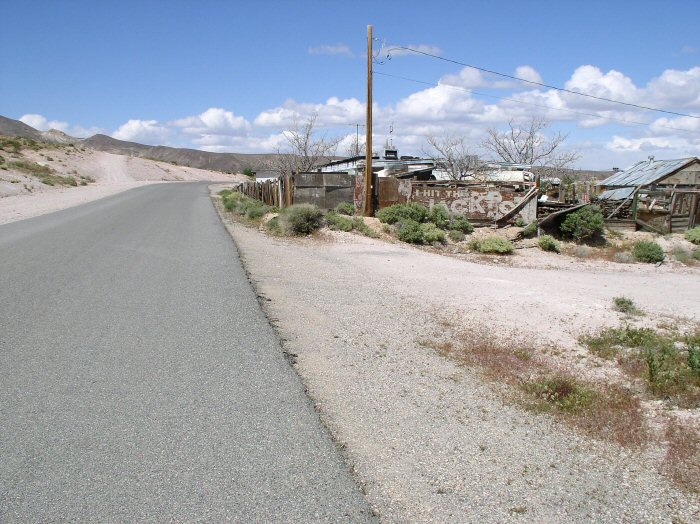
The Amargosa River, which runs mostly underground, bisects the town. Outside the post office, there are air monitors and an information kiosk about monitoring for radiation and health effects. There are some neighborhoods of well-tended, modest houses. There are areas with houses and trailers completely abandoned. There are a few people subsisting in ruins.
John had told me a bit more: Banks won’t mortgage property in Beatty. The water company is raising rates and threatens to go bust.
The historical museum was closed. Except for the casinos and a gas station/convenience store, the information center for the Yucca Mountain nuclear waste dump was the only thing open. I went inside and let the bored Federal employee talk me into watching a 15-minute videotape. A couple of young biologists—also Federal employees—came through on their way back from a survey.
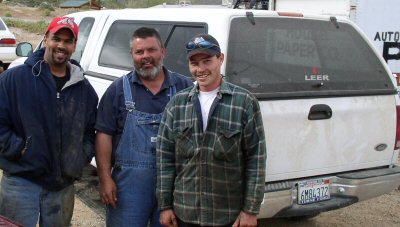
Back at the yard, John’s crew was finishing their installation of the transmission. The three of them kept up a steady course of swearing and trading not-quite-good-natured insults. When they were done, John took me for a test drive. Then we went up to his house. I wanted a copy of his receipt for the transmission.
It turned out he’d marked up the dealer’s cost quite a bit. He’d said he wouldn’t, but I couldn’t complain—he’d transported that transmission, and me, over 100 miles. He charged nine hours for the remove/replace—that was from Ford’s labor guide—at $90 per hour. It had taken his three guys all day, scooting themselves around on plastic mats in the dirt.
Fair enough. I wrote him a check and drove out into an early evening gloom. On the first hills, as I began the 500-mile drive back to Berkeley, I listened carefully for the transmission to shift down.